Inkle Loom or Belt Weaving Kit? What is the Difference?

If you are browsing narrow band weaving kits on our website, you will have come across two options that look quite similar: the Inkle Loom Weaving Kit and the Belt Weaving / Backstrap Weaving Kit. Both produce the same kind of fabric, a narrow, warp-faced woven band with both using the same basic weaving technique: threads are set up as a warp, a heddle or string heddles around which the warp is raised or lowered alternatively to create a shed with a shuttle carrying the weft back and forth.

The difference between them isn't the weave itself. It's how the warp is tensioned. That one distinction shapes almost everything else about how each loom is used.
Both crafts share the same appeal at heart. The over-under rhythm of picking up a shed and passing the shuttle through is repetitive in a good way - quick to learn, satisfying almost from the first row, and easy to settle into without much conscious thought once it clicks. Progress is visible immediately, since every pass adds a clear line to the band, so there's a steady sense of the piece growing as you go. Both are also quick compared with wider fabric weaving: a bookmark-length band can be finished in an evening, and even a full belt is measured in hours rather than the days a larger weaving project might take. And because the finished bands are things people actually use - belts, straps, lanyards, hair ties there is a practical pay-off at the end that a lot of other narrow crafts don't offer. If you are interested in knowing what you can make with a woven belt or braid then you can read our blog '10 beautiful things you can make with an inkle woven braid'.

The Inkle Loom
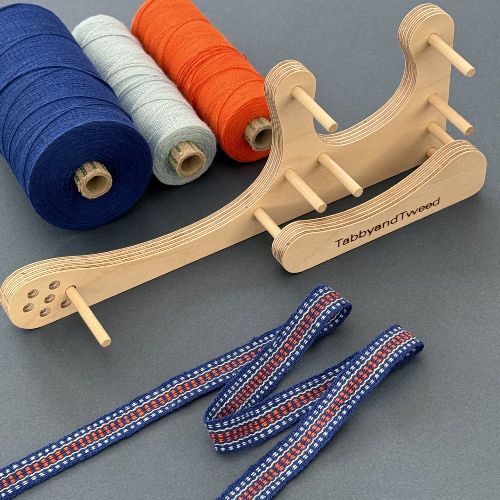
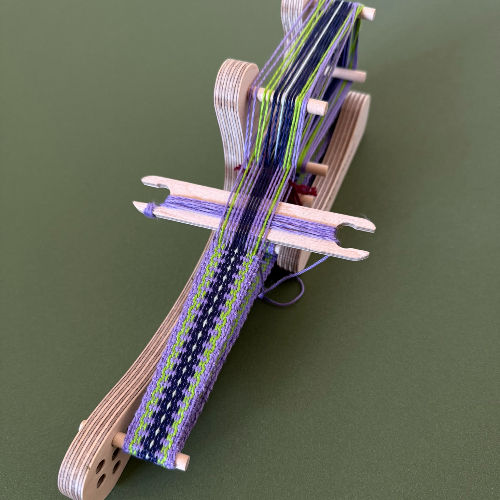
The inkle loom is a small, fixed wooden frame (28cm x 11cm x 5cm) with a set of pegs built into it. The pegs hold the warp under tension on their own, so the loom does the work of keeping the threads taut while you weave.
Advantages
The frame maintains its own tension, so there is nothing to manage with your body or posture while weaving.
It can be used anywhere you can sit - a desk, a sofa, or on your lap and it packs into a bag for weaving on the go.
The kit includes yarn (50m each of three colours of 4-ply cotton), so it's ready to use straight out of the box.
Because tension is more predictable, it tends to be the easier of the two to pick up as a first project and it is easier to create a well finished band with equal tensioning along its length.

Disadvantages
The fixed frame size limits the length of the warp, so finished bands top out at around 80cm - fine for bookmarks, hair ties, lanyards or hat bands, but not long enough for a full-length belt.
Band width is capped at around 2.5cm.
You need the loom itself in order to weave; it isn't something you can improvise with items you already have.
The Belt Weaving / Backstrap Loom

The belt weaving loom uses the same inkle-style shed mechanism, but instead of a frame holding the tension, one end of the warp loops around a fixed point - a door handle, a table leg, a post and the other end loops around the weaver's own body. Tension is controlled by leaning back slightly, which is where the name "backstrap weaving" comes from. It's an old technique, found in weaving traditions across many cultures.

The kit is available in two versions: a standard kit (£30), packaged flat for posting, and a gift box kit (£40), which comes with the heddle already threaded and warped and is presented in a box with tissue paper, ready to give without further wrapping. Both include the same loom, wooden shuttle and instruction booklet. Yarn is included with the gift box version; the standard kit does not include yarn.
Advantages
There's no fixed length limit - the finished band is as long as your yarn supply allows, making it genuinely suited to full-length belts, guitar straps or bag straps, as well as shorter items.
The loom is reusable and can be re-warped with any yarn of a similar weight once the original is used up, so it isn't a one-project tool.
Bands come out slightly wider (around 3–4cm, depending on yarn weight) than those from the inkle loom.
Disadvantages
Controlling tension with your body takes a little more practice than weaving on a self-tensioning frame - most beginners find it accessible within a few hours, but it isn't quite as immediately forgiving as the inkle loom.
You need a fixed anchor point to weave, which makes it slightly less flexible for weaving anywhere you happen to be sitting, compared with the inkle loom.
If you stop weaving mid band it can takes a little time to re-establish the warp tension so it isn’t as easy to stop and start weaving compared to the inkle loom.
Yarn isn't included with the standard kit, so it's an extra consideration unless you choose the gift box version.
Which one should I choose to purchase?
If the finished item you have in mind is shorter than about 80cm - a bookmark, a lanyard, a hair tie then either loom will do the job, and the inkle loom's self-tensioning frame makes it the more straightforward starting point. If you specifically want to weave a full-length belt or strap, the backstrap loom's lack of a length limit makes it the more practical choice, even though it asks a little more of you in terms of tension control while you learn.

Details of all our weaving kits are available in our TabbyandTweed website shop for UK, USA, Canada and New Zealand delivery.
If you are interested in keeping up to date with our weaving work then do sign up to receive our newsletter by clicking the link here.